The first exhibition in France devoted to the work of Noa Eshkol (1924–2007) follows the work of the visionary artist from the 1950s to the 2000s. The exhibition brings together Noa Eshkol’s choreographic compositions, wall carpets, drawings, photographs, and videos, tracing her career trajectory as an artist whose practice moved fluidly between movement and materiality.
Known for developing a radical system of movement notation in the 1950s alongside architect Avraham Wachman, Noa Eshkol was a pioneer of modern dance and dance theory. In 1973, in the shadow of the Yom Kippur War, she turned away from dance and began making wall carpets — assemblages of salvaged fabrics that oscillate between abstraction and landscape. What began as a response to anxiety and a need for repetitive, manual actions, evolved into a body of nearly 2,000 works, positioning her as a central figure in twentieth-century global textile practice.
The exhibition at the mahJ pursues this interdisciplinary path, situating Noa Eshkol’s work in its historical context while tracing its continuing resonance for newer generations of artists. Installations by leading artists Sharon Lockhart and Yael Bartana further highlight the ongoing influence of Noa Eshkol’s visionary practice.
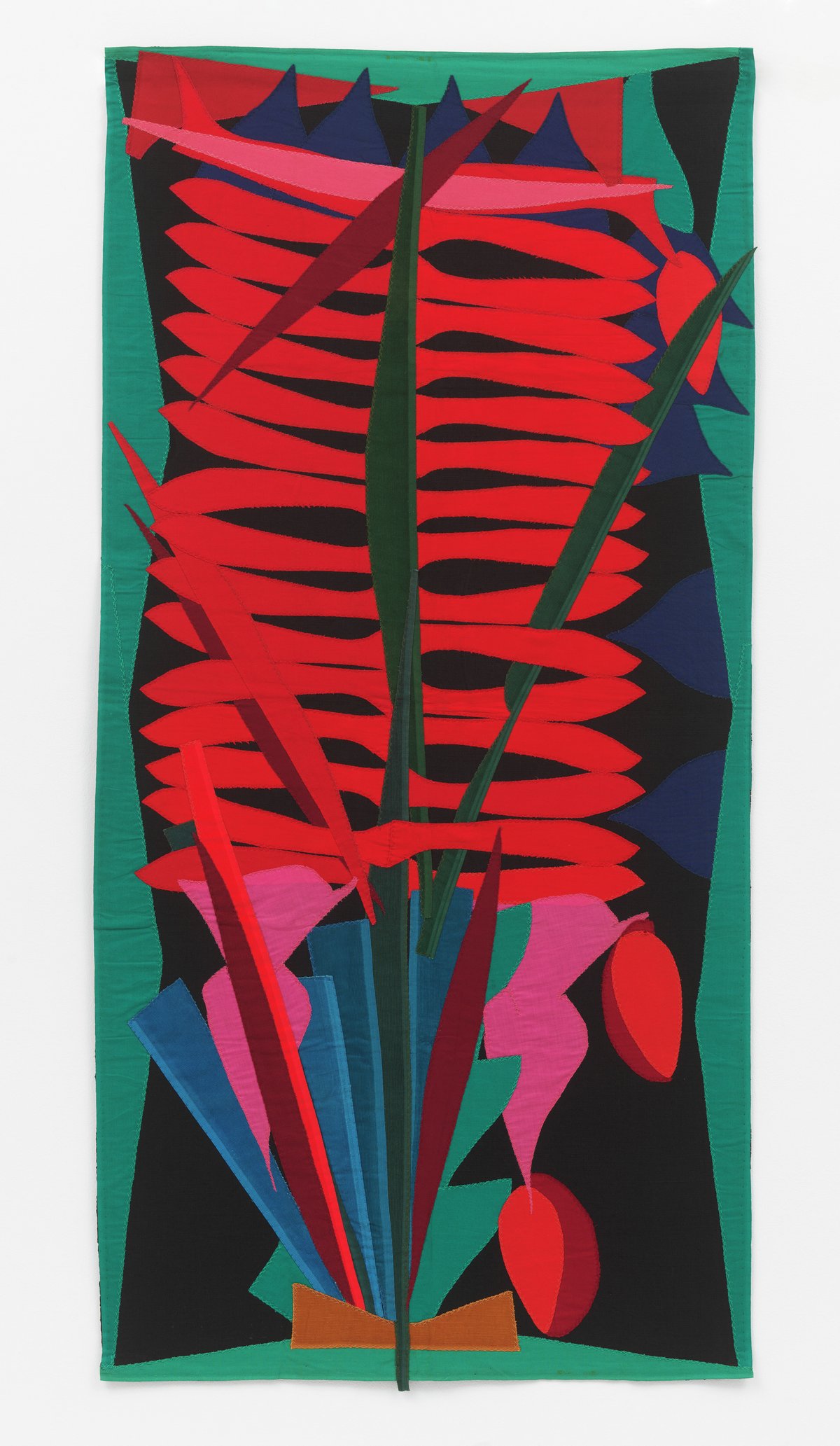
Noa Eshkol, Red Tree, 1990, cotton, corduroy, twill, knitwear, batiste, 181.5 x 87 cm. Courtesy of The Noa Eshkol Foundation for Movement Notation, Holon, Israel, and neugerriemschneider, Berlin, Germany. Photo by Jens Ziehe, neugerriemschneider.